
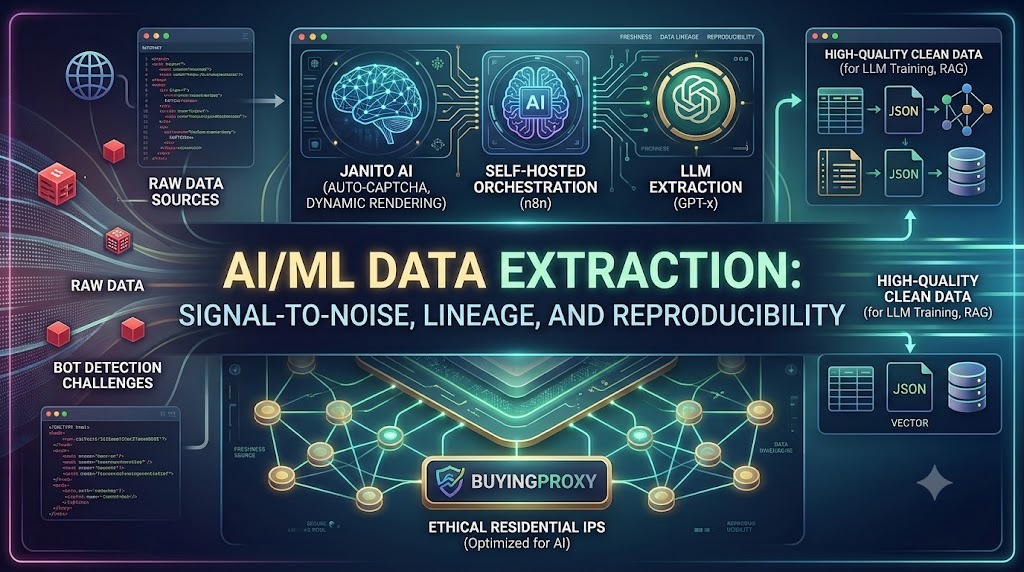
Does your LLM pipeline actually need 10,000 pages per minute, or does it need 500 pages that are perfectly clean, structurally intact, and fresh within the last hour? Most AI/ML teams answer that wrong. Traditional scraping optimizes for raw throughput – more requests, more pages, more bandwidth. AI/ML extraction optimizes for signal-to-noise ratio, data lineage, and reproducibility across model training cycles. These are fundamentally different constraints.
Why AI/ML Changes Scraping Needs
Large language models don’t learn from broken HTML. They learn from structured, deduplicated, timestamped corpora. A Reddit user on r/webscraping captured the pain precisely: “The problem is you often don’t know what it is that’s triggering the bot detection. Is it the typing? Is the mouse on the page? Is it clicking submit? All you get is a fail (if they aren’t poisoning the well too).” Data poisoning is the nightmare scenario for any training pipeline. A site that silently corrupts responses – returning plausible-looking but false data – wastes compute cycles and degrades model performance. Traditional scrapers rarely detect this. AI pipelines must.
The volume requirements differ too. Fine-tuning a domain-specific model might need 50,000-100,000 high-quality documents, not 50 million low-quality ones. Batch inference for RAG retrieval demands freshness – stale product listings or outdated pricing break the retrieval step. One r/ProxyEngineering thread documented a user scraping static HTML pages with Excel VBA in under 15 seconds per extraction. That works for static content. Modern AI targets require dynamic page rendering, JavaScript execution, and real-time CAPTCHA resolution.
LLM Extraction Pipelines and Where Proxies Fit
A typical 2026 LLM extraction pipeline has four stages: discovery, acquisition, parsing, and ingestion. Proxies sit at the acquisition layer, but their role has changed. They’re no longer just IP rotation mechanisms. They’re identity management systems.
The discovery stage identifies target URLs – often from sitemaps, search results, or API endpoints. The acquisition stage fetches rendered HTML. This is where bot detection hits hardest. One user demonstrated that even with headless Chrome flags like –headless=new and –disable-blink-features=AutomationControlled, plus selenium-stealth, Google still served CAPTCHAs. The detection signals are too numerous: WebGL fingerprints, canvas rendering differences, font enumeration, audio context timing. A residential proxy alone won’t fix this. You need a proxy architecture that pairs clean IPs with browser fingerprint randomization.
The parsing stage extracts structured data – often via LLM calls for complex extraction. FireCrawl’s pricing illustrates the cost explosion here: basic scrape costs 1 credit per page. Turn on AI extraction, JSON mode, or the enhanced anti-bot engine, and it jumps to 5-9 credits per page. That’s a 5-9x multiplier for AI-enhanced extraction. For a pipeline processing 10,000 pages daily, that’s 50,000-90,000 credits – a significant operational cost.
The ingestion stage feeds extracted data into vector databases, fine-tuning datasets, or live RAG indexes. Data quality failures upstream cascade here. A single poisoned page can corrupt an entire embedding batch.
Combined Cost Math: Proxy + LLM Stack
Let’s run the numbers for a mid-scale AI scraping operation in 2026. Target: 5,000 pages daily, each page requiring JavaScript rendering and AI extraction.
Proxy costs: Residential proxy networks charge $8-12/GB for bandwidth. A typical rendered page with assets consumes 2-3 MB. At 5,000 pages, that’s 10-15 GB daily. At $8/GB, that’s $80-120/day – $2,400-3,600/month. For comparison, Buyingproxy charges $0.95/GB without the surprise-pricing pattern – same residential architecture, transparent rate. That drops daily bandwidth costs to $9.50-14.25.
LLM extraction costs: OpenAI GPT-4o processes roughly 15,000 tokens per page for complex extraction (input HTML + output schema). At $2.50/1M input tokens and $10/1M output tokens, each page costs approximately $0.02-0.04. For 5,000 pages daily: $100-200/day. Add Pinecone vector storage at roughly $0.10/GB/month per index. Add n8n orchestration costs if self-hosted (free) or cloud-hosted ($20-50/month).
Total monthly stack: Proxy ($2,400-3,600) + LLM ($3,000-6,000) + storage ($50-200) + orchestration ($0-50) = $5,450-9,850/month. The proxy layer represents 25-40% of total cost. Optimizing proxy architecture directly impacts the bottom line.
Vendor Picks for 2026 AI Extraction
Janito AI handles the detection layer. Its playwright-captcha integration works with Cloudflare Interstitial, Turnstile, and reCAPTCHA v2/v3. It automatically detects CAPTCHAs, extracts solving data, and applies the solution. This eliminates the manual CAPTCHA handling that breaks most headless browser pipelines. One Reddit user noted that AI scrapers “faceplant hard” on dynamic sites with proper defenses – Janito directly addresses that failure mode.
n8n (self-hosted) provides orchestration. The tech stack documented by one team: n8n for orchestration, OpenAI GPT-4o for agents, Pinecone for FAQ vector search, Google Sheets as the database, and WhatsApp Cloud API for messaging. This is a production-grade pattern. Self-hosting n8n avoids the data exposure risks of cloud orchestration – one r/sysadmin thread documented a case where customer data and private contracts were emailed to a developer and stored in a webapp without security measures. Self-hosted orchestration keeps data local.
Parity handles authentication and secrets management. It supports Face ID, Touch ID, and fingerprint authentication. API key authentication, encrypted storage, no telemetry, and local-only data. For teams managing multiple proxy credentials, API keys, and LLM tokens, this eliminates the credential sprawl that leads to leaks.
Cloudflare Tunnel provides secure ingress, but with a tradeoff: it exposes unencrypted data to Cloudflare. Users on r/unRAID expressed discomfort with this architecture. For sensitive AI extraction pipelines, consider direct WireGuard tunnels to proxy endpoints instead.
Real-World AI Scraping Architecture Example
Here’s a production architecture from a 2026 AI training pipeline:
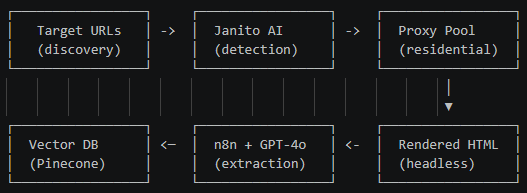
The pipeline starts with URL discovery from sitemaps and search APIs. Janito AI manages the detection layer – it checks for CAPTCHA presence, fingerprinting challenges, and JavaScript detection. If a CAPTCHA appears, playwright-captcha resolves it before the proxy pool even sends the request. This pre-emptive approach reduces proxy consumption by avoiding retries.
The proxy pool uses residential IPs from direct ISP relationships. Each IP handles 5-10 requests per minute, rotated based on response quality. Failed requests (CAPTCHA, 403, rate-limit) trigger immediate IP rotation and feed back into Janito’s detection model.
Rendered HTML passes to n8n’s extraction workflow. GPT-4o extracts structured data according to a Zod-typed schema – every input and output is inferred and validated. This prevents the silent data corruption that plagues regex-based extraction. The extracted data lands in Pinecone for RAG retrieval and in Google Sheets for human review.
A 10-hour training corpus yields approximately 72,000 extracted entries – roughly 5-6 MB of structured data. The entire pipeline runs on a single self-hosted server with 32 GB RAM and a 1 TB SSD. Total monthly cost: roughly $3,200 including proxy bandwidth, LLM inference, and storage. That’s 40-60% cheaper than cloud-only alternatives.
If you’re tired of overpriced residential proxies, Buyingproxy starts at $0.95/GB with no monthly commitment.